| Shark Attack!
Feb.07.2002
SYDNEY, Australia
-- A 35-year-old man has had a harrowing encounter with a shark while paddling a kayak in the habor waters just a few kilometers west of downtown Sydney.
The man was in in his kayak Thursday evening near the Cabarita Marina in the Parramatta River when the shark struck.
He was thrown into the water by the impact and then hit in the chest by the shark, which then began circling him as he swam for help.
The man was able to climb onto a nearby navigational buoy and was rescued by a passing fishing boat.
Water Police examining the kayak found a large bite mark and part of a tooth imbedded in the stern. The man suffered bruising and minor lacerations in the attack, police said.
http://www.sharkattacks.com/
Each year there are about 50 to 70 confirmed shark attacks and 5 to 15 shark-attack fatalities around the world. In most cases an attack leads to damage to the legs and arms and sometimes to other parts of the body. In some cases arms and legs have to amputated in others a few stitches are enough. What causes these shark attacks? Are sharks really hungry for humans? Do they feel attacked and are they only defending themselves?
Many people believe that sharks attack humans because they want to eat them, they are hungry for food and humans can sometimes be an easy prey. This however isn't true, sharks mostly attack humans by accident, because they get to close and the sharks try to defend themselves or because the shark sees the human as something different then a human. Right after a shark has attacked it will either come back and attack again, this means it is defending itself or it will swim away and never return, this means it tasted the human, didn't like him and swam away.
To understand why sharks attack you have to go a bit deeper into the shark, below the skin, its senses. Different from humans sharks have 6 senses, the usual: Taste, Hearing, Touch, Eyesight and Smell. Besides that the shark has a very special sense, Electricity.
Taste: Although sharks do have taste buds in their mouth, they don't have a tongue like humans do. Their taste isn't great but enough for a shark to taste its prey.
( http://web.ncf.ca/bz050/tongue.html )
Hearing: Sharks are very sensitive to low frequency sounds and have good directional hearing. The endolymphatic pores on the top of a shark's head are the only external evidence of its ears. Inside the endolymphatic pores are the endolymphatic ducts which lead to the macula neglecta and a series of semicircular canals with which sharks hear.

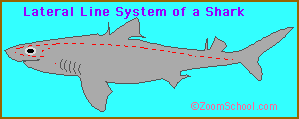
Touch: Sharks can sense vibrations in the water using a the lateralis system. The "lateral line" system is a network of neuromasts, which are fine, fluid-filled vessels that run along a shark's body under the skin along the length of a shark. Many small pores open up on the skin, detecting the intensity and direction of vibrations in the water. This system enables the shark to detect injured fish (easy prey) that are thrashing around in the water.
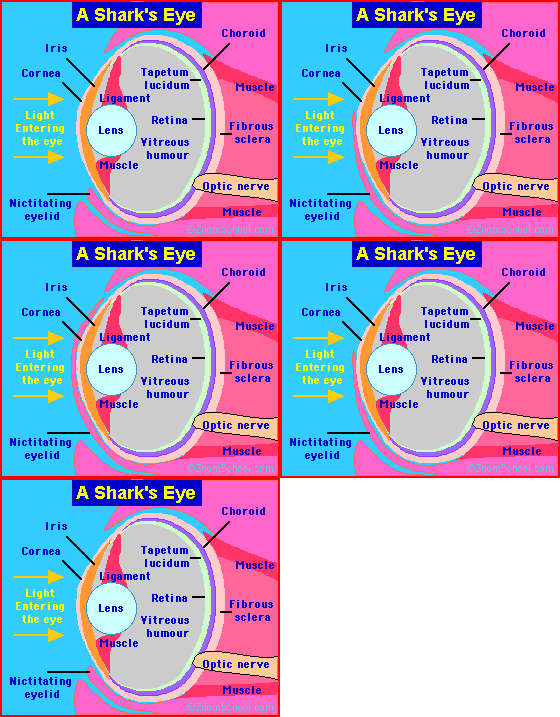
Eyesight: Sharks have good eyesight; they have color vision. Shark eyes have a large, spherical lens, a cornea, a retina (with both rods and cones), an iris, and a pupil. They even have good vision in dim light. Sharks, like cats who also see well in dim light, have a mirror-like layer in the back of the eye, the tapetum lucidum. This layer doubles the intensity of incoming light, enhancing light sensitivity. Unlike other fish, shark's pupils can dilate and contract to control the amount of incoming light. The retina has a greater proportion of rods (light intensity sensors) than cones (color sensors), so sharks are very sensitive to small differences in light intensity (dark versus light).
Some sharks (Carchariniformes) have a nictitating membrane, a type of eyelid that protects the eye during hunting.
Sharks that live deeper in the oceans usually have larger eyes than those that live nearer the surface.
Smell: A shark's primary sense is a keen sense of smell. It can detect one drop of blood in a million drops of water (25 gallons or 100 liters) and can smell blood 0.25 mile (0.4 km) away. Its paired nostrils are on the underside of its snout. Water continually flows through the nostrils, giving the shark olfactory information. Unlike humans, shark nostrils have nothing to do with breathing - they are not even connected to the mouth.
Some sharks, like the nurse shark, have sensory projections near the nostrils and mouth called nasal barbels. These barbels are whisker-like feelers used to taste and feel.
Electricity: Sharks can detect electricity, which is emitted in small amounts by every living animal. Sharks may be more sensitive to electric fields than any other animal. Sharks have a special network of jelly-filled canals in their head called the ampullae of Lorenzini that detect electric fields. This lets the shark pick up weak electrical stimuli from the muscle contractions of animals. It may also serve to detect magnetic fields which some sharks may use in navigation. These canals can be seen on the sharks face in form of little black dots.
Now because the sight underneath the water surface towards the water surface is very bad because of the blinding sun sometimes shark sees humans for other preys. Because of the movement by humans it senses them and may think it's a different prey. Because humans are not normally sea animals sharks are not used to eating human flesh and they won't like it. So the myth that sharks do like humans and they attack them for dinner is untrue.
Some facts that are true about sharks:
Over 375 shark species have been identified, but only about a dozen are considered particularly dangerous. Three species are responsible for most human attacks: great white (Carcharodon carcharias), tiger (Galeocerdo cuvier), and bull (Carcharhinus leucas) sharks.
While sharks kill fewer than 20 people a year, their own numbers suffer greatly at human hands. Between 20 and 100 million sharks die each year due to fishing activity, according to data from the Florida Museum of Natural History's International Shark Attack File. The organization estimates that some shark populations have plummeted 30 to 50 percent.
The shortfin mako (Isurus oxyrinchus) is often recognized as the world's speediest shark. It has been clocked at speeds of up to 20 miles an hour (32 kilometers an hour) and can probably swim even faster than that. Makos are fast enough to catch even the fleetest fish, such as tuna and swordfish.
Sharks are known as eating machines. But because many species are cold-blooded, some sharks eat only about 2 percent of their body weight each day. That's a bit less than humans typically eat.
National Geographic
Statistics on shark attacks and attacking species
-------------------------
[i]Roland Wouters 2007[/i]
|